• Welcome to your new Gnomio site

    Now, you are in control!

    Moodle is an open-source Learning Management System (LMS) that provides educators with the tools and features to create and manage online courses. It allows educators to organize course materials, create quizzes and assignments, host discussion forums, and track student progress. Moodle is highly flexible and can be customized to meet the specific needs of different institutions and learning environments.

    Moodle supports both synchronous and asynchronous learning environments, enabling educators to host live webinars, video conferences, and chat sessions, as well as providing a variety of tools that support self-paced learning, including videos, interactive quizzes, and discussion forums. The platform also integrates with other tools and systems, such as Google Apps and plagiarism detection software, to provide a seamless learning experience.

    Moodle is widely used in educational institutions, including universities, K-12 schools, and corporate training programs. It is well-suited to online and blended learning environments and distance education programs. Additionally, Moodle's accessibility features make it a popular choice for learners with disabilities, ensuring that courses are inclusive and accessible to all learners.

    The Moodle community is an active group of users, developers, and educators who contribute to the platform's development and improvement. The community provides support, resources, and documentation for users, as well as a forum for sharing ideas and best practices. Moodle releases regular updates and improvements, ensuring that the platform remains up-to-date with the latest technologies and best practices.

    Links of interest:

    (You can edit or remove this text)
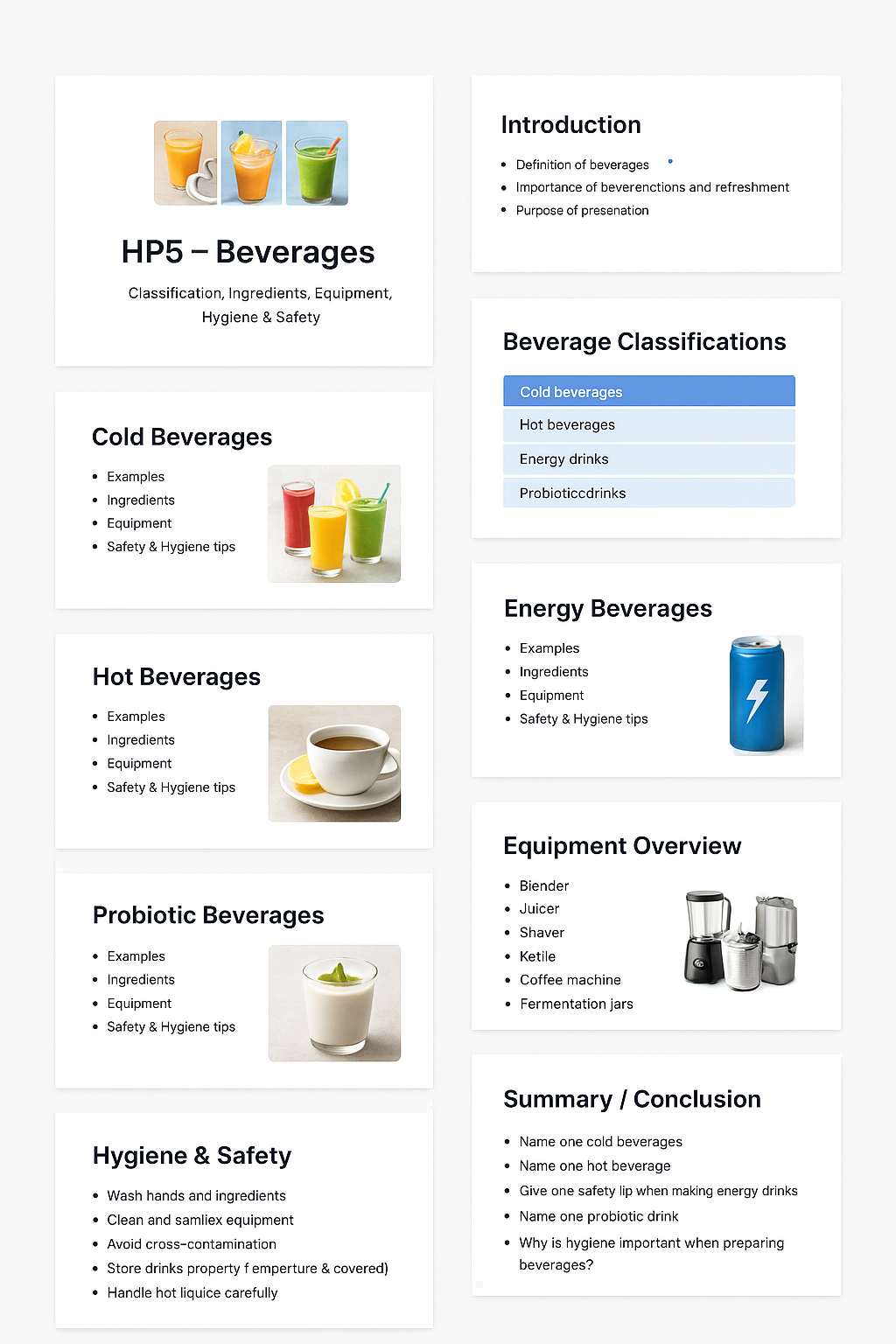
    • This unit equips trainees with the knowledge and practical skills required to prepare, present, and handle a wide range of beverages in a professional food production environment. The unit begins by introducing trainees to the definition and classification of beverages, essential cover equipment, and workplace safety measures such as PPE, hygiene, and sanitation practices. Learners then explore major beverage categories including hot beverages, cold beverages, energy drinks, and probiotic beverages, studying their ingredients, preparation procedures, presentation styles, nutritional importance, and applications in hospitality.

      Emphasis is placed on hands-on practice, standard recipe use, sensory quality, and professional presentation techniques. Trainees learn how to prepare beverages using commercial equipment such as blenders, coffee makers, juicers, and brewing tools, while applying safety and hygiene procedures throughout the process. Additionally, the unit covers the care, cleaning, and preventive maintenance of beverage equipment, ensuring trainees understand how to maintain operational standards and prolong equipment lifespan.

      By completing this unit, trainees gain foundational and advanced skills needed to confidently produce, present, and evaluate beverages in hotels, restaurants, catering establishments, and other food production settings. The module supports competency in beverage production, quality control, workplace safety, and professional service standards.
Available courses

Learn how to prepare, serve, and handle a variety of beverages professionally! This course covers hot and cold drinks, energy drinks, and probiotic beverages, with a focus on hygiene, safety, and proper use of equipment. Gain practical skills and confidence to create high-quality beverages in any hospitality settinDifferent classification of beverages
g.